

|
|
|
Ecologies
Index | Sightseeing | Area Information | Hiking | Camping | Wilderness Adventures | Additional Images
Lowland Forest | Subalpine | Alpine | River | Lake | Coastline | Rain Forest
Western Hemlock
Zone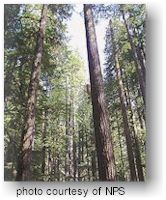 The lowland
forest grows further inland from the coast, and above the rain forest
valleys. You will not find Sitka spruce here, but you may see grand fir.
Western hemlock will probably be the most common tree, although stands of
Douglas-fir may prevail where fire or drier conditions caused by the rain
shadow give these trees an advantage. Western redcedar is never an
abundant tree, but its gradual disappearance is a true indicator that the
upper limits of this zone have been reached. The lowland
forest grows further inland from the coast, and above the rain forest
valleys. You will not find Sitka spruce here, but you may see grand fir.
Western hemlock will probably be the most common tree, although stands of
Douglas-fir may prevail where fire or drier conditions caused by the rain
shadow give these trees an advantage. Western redcedar is never an
abundant tree, but its gradual disappearance is a true indicator that the
upper limits of this zone have been reached.
This zone starts at lower elevations and extends up to about 2,000 feet, or where the silver fir zone begins. Dominant tree species within this zone include Douglas-fir and western hemlock, with western redcedar, grand fir, red alder, and big leaf maple also occurring within this zone. Unlike some other areas of the park, low-elevation stands around Lake Crescent also contain madrone, Pacific dogwood and Douglas maple. In very old stands, the dominant species includes western hemlock and western redcedar. Analysis of digital (GIS) data indicates that the majority of the watershed falls into this zone. Common shrubs include salal, Oregon grape, red huckleberry, Alaska huckleberry, rose and salmonberry. Herbaceous plants include swordfern, deerfern, twinflower, violet, vanillaleaf, trillium, and foamflower (Henderson et al. 1989). Mountain Hemlock Zone or Subalpine fir Zone 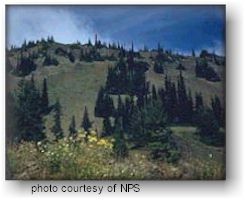 As
elevation increases, temperatures cool and more moisture falls as snow
during the long winters; growing seasons get shorter and the subalpine
zone takes over. Pacific silver fir grows here as well as in the Montane
Zone, and in the western portion of the park may be prevalent. The
presence of mountain hemlock, subalpine fir, or Alaska yellow-cedar groves
assure you that this is the subalpine zone. The lower portion of the
subalpine zone consists of continuous forest, but in the upper part of
this zone the forest thins out. Delightful subalpine meadows graced with
wildflowers and glacial lakes often intermingle with stands of firs.
Subalpine fir is especially well adapted to the heavy snows and cold
temperatures experienced here. Its spire-like shape sheds snow. It also
extends its lower branches under the snow, often putting down roots where
they touch the ground. When the snow melts the trees may be surrounded by
skirt-like arrangements of longer, lower branches. Common shrubs
within this zone include Alaska huckleberry, oval-leaf huckleberry,
blue-leaf huckleberry, white rhododendron, mountain ash, and red heather.
Herbs include five-leaved bramble, trailing bramble, avalanche lily,
queen’s cup, beargrass, and pyrola. In eastern portions of Olympic,
summer heat dries out the soils, limiting the growth of mountain hemlock
trees. There, the subalpine fir and Lodgepole pine dominate drier
sun-facing slopes. As
elevation increases, temperatures cool and more moisture falls as snow
during the long winters; growing seasons get shorter and the subalpine
zone takes over. Pacific silver fir grows here as well as in the Montane
Zone, and in the western portion of the park may be prevalent. The
presence of mountain hemlock, subalpine fir, or Alaska yellow-cedar groves
assure you that this is the subalpine zone. The lower portion of the
subalpine zone consists of continuous forest, but in the upper part of
this zone the forest thins out. Delightful subalpine meadows graced with
wildflowers and glacial lakes often intermingle with stands of firs.
Subalpine fir is especially well adapted to the heavy snows and cold
temperatures experienced here. Its spire-like shape sheds snow. It also
extends its lower branches under the snow, often putting down roots where
they touch the ground. When the snow melts the trees may be surrounded by
skirt-like arrangements of longer, lower branches. Common shrubs
within this zone include Alaska huckleberry, oval-leaf huckleberry,
blue-leaf huckleberry, white rhododendron, mountain ash, and red heather.
Herbs include five-leaved bramble, trailing bramble, avalanche lily,
queen’s cup, beargrass, and pyrola. In eastern portions of Olympic,
summer heat dries out the soils, limiting the growth of mountain hemlock
trees. There, the subalpine fir and Lodgepole pine dominate drier
sun-facing slopes.
A Treeless World 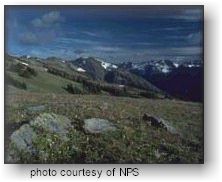 Increasing elevation
causes even more severe climatic conditions. Trees become fewer, shorter,
and more contorted. Trees are dwarfed compared to their cousins living
lower down the mountain--a 100-year-old tree may be only three feet tall.
Eventually tree line is reached, beyond which trees do not grow, but a
profusion of wildflowers often rewards your eye in a vivid display of
insect attracting colors. These small flowering plants dominate the
landscape. They huddle together in groups of different species. Plants
that form these mats are sometimes called cushion plants. Increasing elevation
causes even more severe climatic conditions. Trees become fewer, shorter,
and more contorted. Trees are dwarfed compared to their cousins living
lower down the mountain--a 100-year-old tree may be only three feet tall.
Eventually tree line is reached, beyond which trees do not grow, but a
profusion of wildflowers often rewards your eye in a vivid display of
insect attracting colors. These small flowering plants dominate the
landscape. They huddle together in groups of different species. Plants
that form these mats are sometimes called cushion plants.
Olympic's Circulatory System 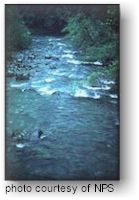 Your body
transfers nutrients through a network of streams and rivers we call
arteries and veins. Arteries and veins feed your cells just like rivers
feed Olympic's forests. Rivers carry nutrients to the forests by way of
fish, insects and other animals that live in this aqueous world. These
animals are the red-blood cells of Olympic's rivers. Anadromous fish, such
as salmon, play a crucial role in feeding the forests. They spend much of
their life at sea building up strength and energy for their return trip
home. After two to four years they "smell" their way back
upriver to the clean, cool beds of gravel to spawn. After laying thousands
of eggs, salmon die. Their carcasses line the riverbanks and supply a
wealth of nourishment to forest animals. Thus, the ocean's bounties are
circulated back into the forest community. Your body
transfers nutrients through a network of streams and rivers we call
arteries and veins. Arteries and veins feed your cells just like rivers
feed Olympic's forests. Rivers carry nutrients to the forests by way of
fish, insects and other animals that live in this aqueous world. These
animals are the red-blood cells of Olympic's rivers. Anadromous fish, such
as salmon, play a crucial role in feeding the forests. They spend much of
their life at sea building up strength and energy for their return trip
home. After two to four years they "smell" their way back
upriver to the clean, cool beds of gravel to spawn. After laying thousands
of eggs, salmon die. Their carcasses line the riverbanks and supply a
wealth of nourishment to forest animals. Thus, the ocean's bounties are
circulated back into the forest community.
What happens when we clog our rivers’ arteries with dams? What happens to a river’s ability to transfer nutrients from the oceans to the forests? Rivers face many new hazards in today's world: fishery reductions, habitat destruction from logging along a river’s edge, run-off pollution from roads and development, water use from growing populations, water flow shifts due to climate change. Olympic National Park's rivers are protected from some of these impacts, but further protection depends on you.
Lake Gouging After the Ice
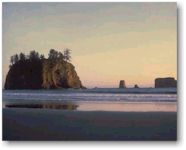
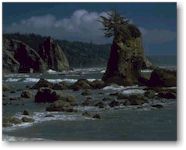
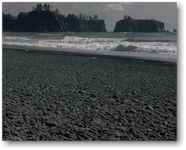
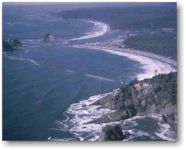
Coastline
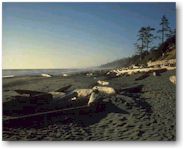
Sand Point to Rialto
Rialto to Oily City
Oil City to Kalaloch
Ocean-Born Forests The dominant species in the rain forest are Sitka spruce and western hemlock; some grow to tremendous size, reaching 300 feet in height and 23 feet in circumference. Douglas-fir, western redcedar, bigleaf maple, red alder, vine maple, and black cottonwood are also found throughout the forest. Nearly every bit of space is taken up with a living plant. Some plants even live on others. These are the epiphytes, plants that do not come into contact with the earth, but also are not parasites. They are partly responsible for giving the rain forest its "jungly" appearance. Mosses, lichens and ferns cover just about anything else. Oregon oxalis is also a common ground cover. But because of this dense ground cover it is hard for seedlings to get a start. Many seedlings germinate on fallen, decaying trees. As they grow they send their roots down the log to the ground. Eventually the log rots completely away and a row of young trees is left, up on stilt-like roots, all in a row. The thick and protective vegetation also provides excellent habitats for the animals of the rain forest. In turn, they contribute to the health of the forest by keeping the rampant vegetation under control by browsing.
|
||||||||||||
|
For Additional Information Contact: Olympic
National Park
For more information visit the National Park Service website
|
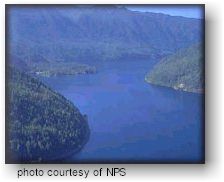 The majority
of lakes found in Olympic were formed by gouging glaciers. Large lowland
lakes, such as Ozette and Lake Crescent, were dug by huge continental ice
sheets that poured out of Canada over 13,000 years ago. Smaller
highcountry lakes and tarns were carved by alpine glaciers. As the ice
melted away, the eroded depressions filled with meltwater.
The majority
of lakes found in Olympic were formed by gouging glaciers. Large lowland
lakes, such as Ozette and Lake Crescent, were dug by huge continental ice
sheets that poured out of Canada over 13,000 years ago. Smaller
highcountry lakes and tarns were carved by alpine glaciers. As the ice
melted away, the eroded depressions filled with meltwater.  Shi
Shi to Sand Point
Shi
Shi to Sand Point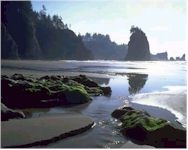
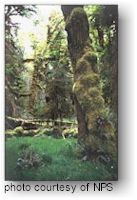 The temperate
rain forest in the valleys of the Quinault, Queets, and Hoh rivers are
protected and contain some of the most spectacular examples of undisturbed
Sitka spruce/western hemlock forests in the lower 48 states. This
ecosystem stretches along the Pacific Coast from Oregon to Alaska; other
temperate rain forests are found in several isolated areas throughout the
world. What defines a rain forest quite simply is rain--lots of it.
Precipitation here ranges from 140 to 167 inches--12 to 14 feet--every
year. The mountains to the east also protect the coastal areas from severe
weather extremes. Seldom does the temperature drop below freezing in the
rain forest and summertime highs rarely exceed 80 F.
The temperate
rain forest in the valleys of the Quinault, Queets, and Hoh rivers are
protected and contain some of the most spectacular examples of undisturbed
Sitka spruce/western hemlock forests in the lower 48 states. This
ecosystem stretches along the Pacific Coast from Oregon to Alaska; other
temperate rain forests are found in several isolated areas throughout the
world. What defines a rain forest quite simply is rain--lots of it.
Precipitation here ranges from 140 to 167 inches--12 to 14 feet--every
year. The mountains to the east also protect the coastal areas from severe
weather extremes. Seldom does the temperature drop below freezing in the
rain forest and summertime highs rarely exceed 80 F.